
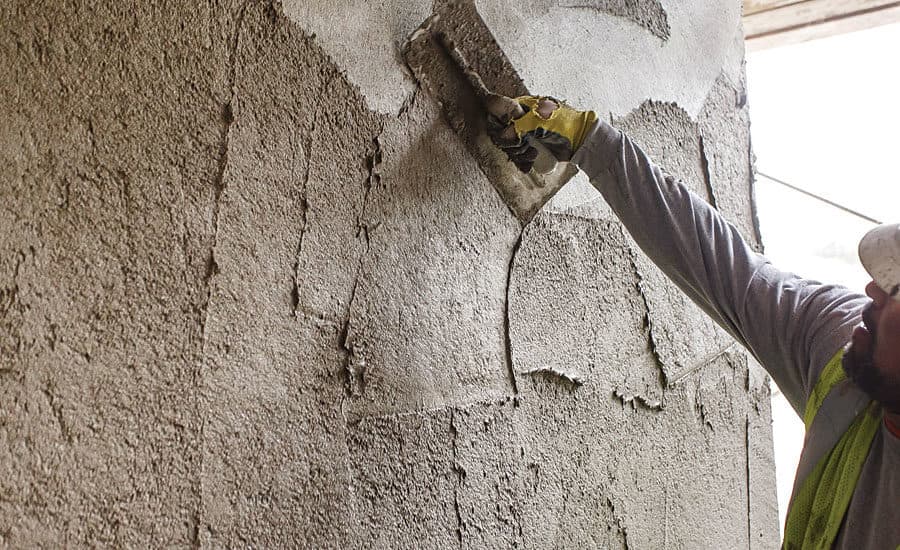
People use the word stucco for two very different wall systems, and the difference matters when you are building, buying, or repairing a home in Southern Utah. One is traditional three-coat hard-coat stucco: cement plaster over lath, built up in layers to about seven-eighths of an inch thick. The other is EIFS, short for Exterior Insulation and Finish System, which is a foam board glued or fastened to the wall with a thin synthetic coating troweled over it.
From the street they can look nearly identical. Up close, there is a simple test: knock on the wall. Hard-coat stucco sounds and feels like concrete because it essentially is. EIFS sounds hollow and gives slightly under a firm press, because under that thin coating is an inch or more of foam.
Start with impact resistance, because this is the most practical daily difference. Three-coat stucco shrugs off ladders, weed trimmers, hail, kids with bikes, and moving-day furniture. EIFS dents. The finish coating over the foam is only a fraction of an inch thick, so a sharp knock leaves a divot that has to be patched. On a wall that takes abuse, near driveways, patios, and play areas, hard-coat earns its keep.
EIFS wins the insulation argument, and it is not close. The foam board adds continuous insulation across the entire wall, covering the studs that normally act as thermal bridges. In a climate where summer cooling is the big utility line item, that continuous layer is a genuine advantage. Hard-coat stucco adds mass but very little insulating value on its own; the insulation lives in the stud cavities behind it.
That thermal mass is not worthless here, though. A thick cement wall absorbs heat through our brutal afternoons and releases it slowly in the evening, which flattens out the indoor temperature swing. In the high desert around Cedar City, where nights drop hard even in summer, that mass effect is something you can actually feel.
Moisture is where EIFS earned its bad reputation, and where the story has changed. The original barrier-style EIFS from decades past had no way to drain water that got in behind it, and in wetter climates it rotted sheathing and framing. Modern drainage EIFS fixed this: a water-resistive barrier goes on the wall first, and drainage channels behind the foam give any intruding water a path down and out through weeps at the bottom.
In our dry climate the moisture risk is lower than in the Southeast, but do not let anyone tell you it is zero. Monsoon storms drive rain sideways, and irrigation hits walls year round. Whichever system you choose, the details decide everything: flashing at windows and roof lines, sealed penetrations, weep screeds at the base, and kickout flashing where a roof meets a wall.
Hard-coat stucco manages moisture differently. It is a reservoir system: the cement absorbs some water, then dries out fast in our heat and low humidity, while two layers of water-resistive barrier behind the lath protect the framing. Southern Utah is close to the ideal climate for this system, which is a big part of why three-coat stucco dominates here and across the Southwest.
What do inspectors and appraisers look at? On EIFS, they check for the drainage type, intact sealant joints, foam terminated above grade rather than running into the soil where termites and moisture can travel, and no woodpecker or impact damage left open. On hard-coat, they look for proper weep screeds, control joints, flashing, and cracks that have been maintained. On resale, some buyers and lenders still flinch at the word EIFS, fairly or not, so ask your agent how it plays in your market.
There is also a hybrid worth knowing about: one-coat stucco over foam, common in production building around St. George. It puts a thinner cement layer, roughly half an inch, over foam board, splitting the difference on insulation and impact resistance. It is a legitimate system when installed correctly, but it is less forgiving of shortcuts than true three-coat.
On cost, the honest answer is that it depends on wall complexity, insulation requirements, labor market, and finish choice, and the gap between systems is smaller than people assume. What drives cost more is detail work: lots of corners, pop-outs, foam trim profiles, and multiple colors. Get quotes on your actual plans rather than trusting a rule of thumb.
Our take after decades of plastering across Washington, Iron, and Kane counties: for most Southern Utah homes, three-coat hard-coat stucco is the default for good reason. It matches the climate, takes abuse, and repairs cleanly. EIFS makes sense when energy performance is the priority and the installer sweats the drainage details. Either way, the installer matters more than the brochure, so ask who is actually doing the lath and the coats, and how long they have been doing it here.
How can I tell if my house is stucco or EIFS?
Knock on the wall in a few places. Traditional stucco feels rock hard and sounds solid because it is nearly an inch of cement. EIFS sounds hollow and flexes slightly under a firm press because there is foam board under a thin coating. You can also check at an outlet or fixture cut-out, where the layers are visible.
Is EIFS bad in a hot, dry climate like St. George?
No. The moisture failures that gave EIFS a bad name mostly happened with older barrier-style systems in wet climates. Modern drainage EIFS installed with proper flashing performs well in the desert, and its continuous foam insulation helps with summer cooling costs. Installation quality is the deciding factor.
Which lasts longer, stucco or EIFS?
Properly installed, both can last 50 years or more. Hard-coat stucco tends to age more gracefully in the Southwest because it resists impact damage and UV exposure well, needing only crack sealing and periodic recoating. EIFS lasts too but depends on keeping sealant joints maintained and repairing dents promptly.