
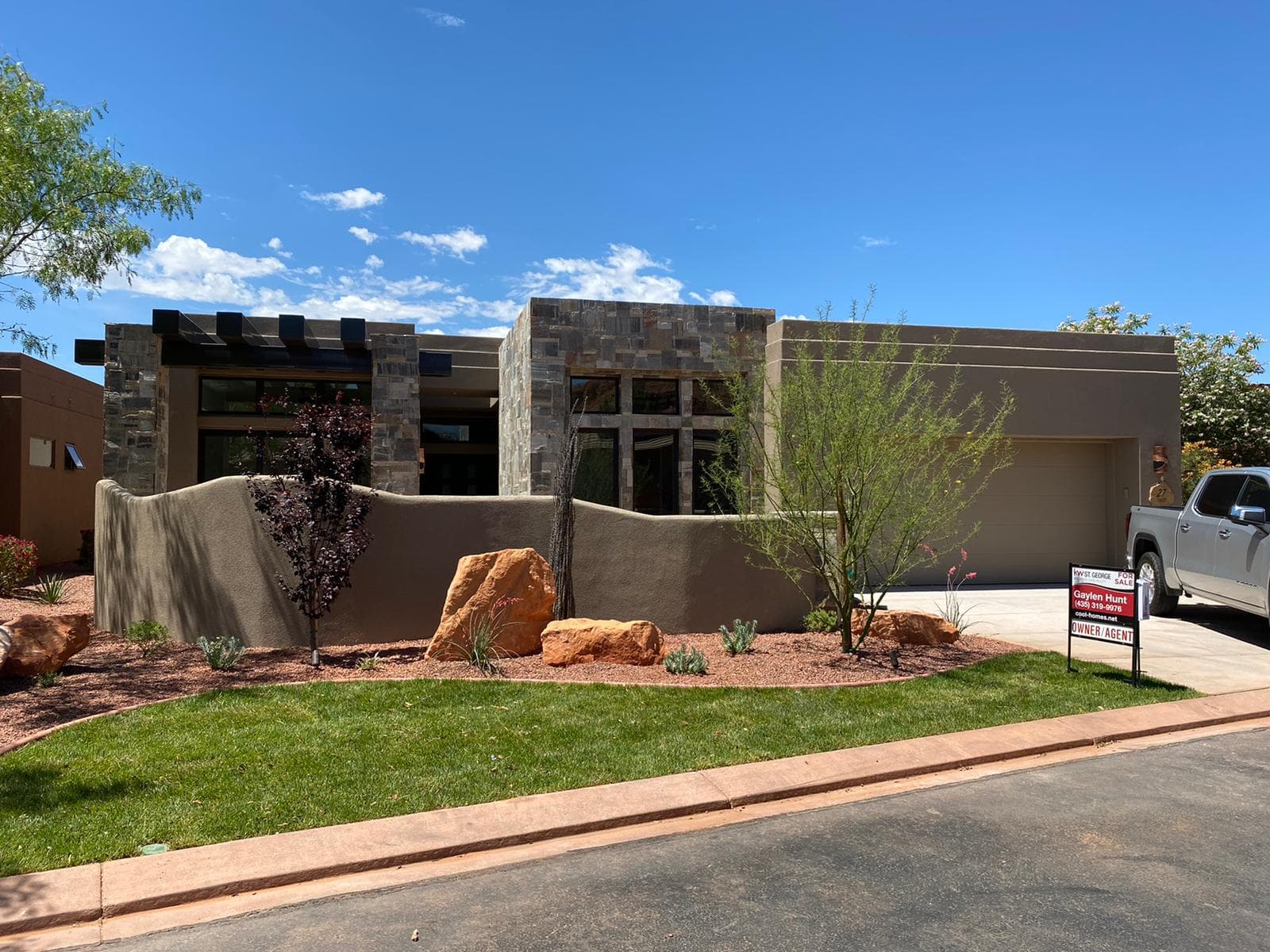
The finish texture is the one stucco decision everybody sees, every day, for the life of the house. It sets the character of the home from the curb, it changes how the wall handles our intense sunlight, and, something almost nobody thinks about at selection time, it determines how invisible future repairs can be. Here is a working guide to the common textures, from a crew that has troweled all of them across Southern Utah.
Smooth finish, often called santa barbara or smooth trowel, is the high end of the craft. The finish coat is troweled tight and flat, sometimes with subtle mottling and trowel movement that gives the wall a soft, hand-made depth. On the right architecture, Spanish colonial, contemporary, or the clean-lined desert modern going up around St. George, nothing else comes close.
It is also the least forgiving texture there is. A smooth wall hides nothing: every wave in the brown coat, every hairline crack, every patch shows in raking morning and evening light, which we get plenty of here. It demands the most skilled labor and the flattest base coats, which makes it the most expensive texture to do right and the hardest to repair invisibly. Choose it with your eyes open, and expect touch-up work over the years to sometimes mean recoating a full wall plane.
Sand finish, also called float finish, is the workhorse. The finish coat carries a graded sand, and the crew floats it to an even, fine-grained surface. It is clean and quiet from the curb, it suits nearly any style, and it is one of the most repairable textures because a good plasterer can float a patch into the surrounding field and make it disappear. If you want a safe, timeless choice, this is it.
Dash finish is sprayed rather than troweled, leaving a uniformly pebbled, slightly rough surface. It ranges from a fine dash to a heavy one, and you will see it on plenty of production homes around Washington County because it applies fast and hides base-coat imperfections well. The texture masks hairline cracks better than smooth finishes, and small repairs blend easily since the sprayed pattern has no trowel signature to match.
Lace, also called skip trowel, is probably the most common texture in the Southwest. Material is dashed or troweled on, then knocked down and skipped over with the trowel, leaving a layered pattern of flats and valleys. It hides sins well, repairs well in skilled hands, and reads as classic Southwest without trying hard. The pattern varies from tight to open, so look at real houses, not sample boards alone, when picking your version.
Cat face, sometimes called montalvo, is a smooth or lightly floated field interrupted by intentional rough patches, the inclusions that give the texture its name. It splits the difference between smooth sophistication and textured forgiveness. The catch is consistency: the size and rhythm of the inclusions is a signature of the individual plasterer, which makes matching an existing cat face wall one of the trickier repair jobs we do.
Texture and sunlight interact more here than in most places. Heavy textures throw small shadows that shift all day and give a wall life, but they also collect dust and hold sprinkler deposits in their valleys. Smooth walls stay cleaner and rinse off easily, but they show every surface flaw in low-angle light. On a west-facing wall that takes the full Southern Utah afternoon, that tradeoff is worth a minute of real thought.
Now the part we wish more people heard before choosing: texture determines repairability. Every stucco wall will need a repair someday, a crack, a plumbing penetration, a patch after a window replacement. On sand, dash, and lace, a good crew can match the pattern and feather it in so you cannot find the patch. On smooth and cat face, matching is genuinely hard, and the honest fix often involves recoating wall to wall, corner to corner, so there is no visible seam.
Matching existing texture is its own craft. When we patch a wall, we are matching three things at once: the texture pattern, the tool technique of whoever did it originally, and the color, which has been fading under desert UV since the day it was applied. That is why a proper repair feathers wide, tests the pattern in an inconspicuous spot, and often finishes with a fog coat or paint across the full plane to unify color.
A word on color while we are here. Integral color in a cement finish weathers to a soft, slightly varied patina; acrylic finishes hold their color truer and resist UV fade better, which matters on our south and west exposures. Darker colors show efflorescence and patching more, and they run hotter, which works the wall harder through our temperature swings. Mid-tone desert colors are popular here for good reasons beyond taste.
If you are choosing a texture for a new build or a re-stucco, do the simple thing: drive the neighborhoods around St. George, Santa Clara, and Ivins in the evening, when the low sun makes every texture show its character, and photograph walls you like. Bring us the photos. We can tell you what the texture is, what it takes to execute well, and what it will mean the day the wall needs its first repair. That conversation costs nothing and saves regret.
What is the most popular stucco texture in the Southwest?
Lace, also called skip trowel, is the most common, with sand float close behind. Lace suits Southwest architecture, hides minor imperfections and hairline cracks, and repairs well. Smooth santa barbara finishes have grown popular on contemporary desert homes but cost more and demand more skill.
Can you change the texture of existing stucco?
Yes. Going from a light texture to a heavier one is straightforward: a new finish coat goes over the prepared existing surface. Going from heavy to smooth is harder, usually requiring a leveling coat first to bury the old pattern. Either way it is a full recoat of the wall planes involved, not a spot treatment.
Why does my stucco patch look different from the rest of the wall?
Two reasons: texture and fade. The patch pattern has to replicate the original plasterer's hand, and even a perfect color match will look newer because the surrounding wall has faded under years of desert sun. Skilled feathering fixes the texture side; a fog coat or repaint across the whole plane fixes the color side.